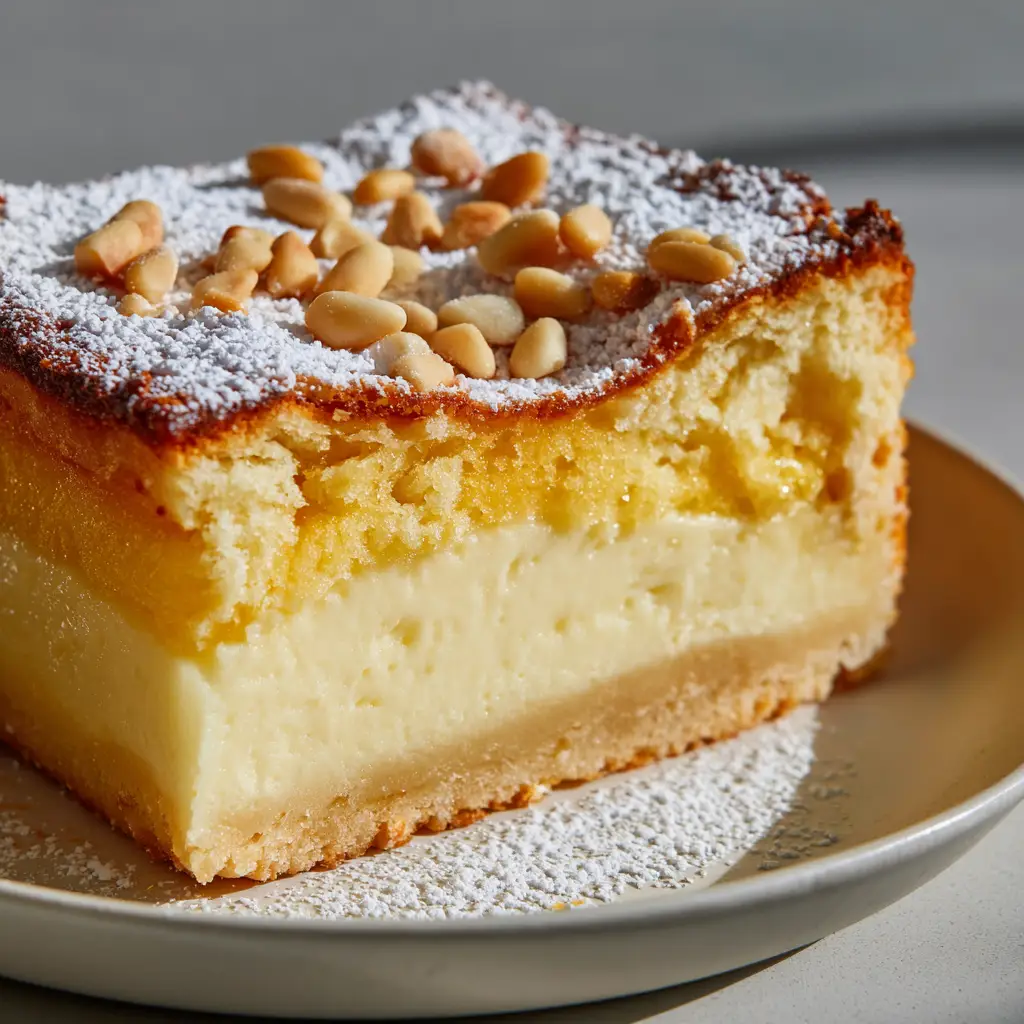
Every breathtaking slice of this authentic Italian Lemon Custard Cake reveals a meticulously crafted visual anatomy that will immediately captivate your guests. Inspired by traditional Italian bakery techniques, this elegant dessert balances bright, sunny citrus notes with a profoundly comforting, buttery richness.
If you crave a baked, buttery golden-brown shortcrust pastry base that perfectly encases a thick and dense middle layer of smooth, pale yellow glossy lemon custard, you are in the exact right place. This recipe meticulously bridges the gap between professional culinary science and accessible home baking.
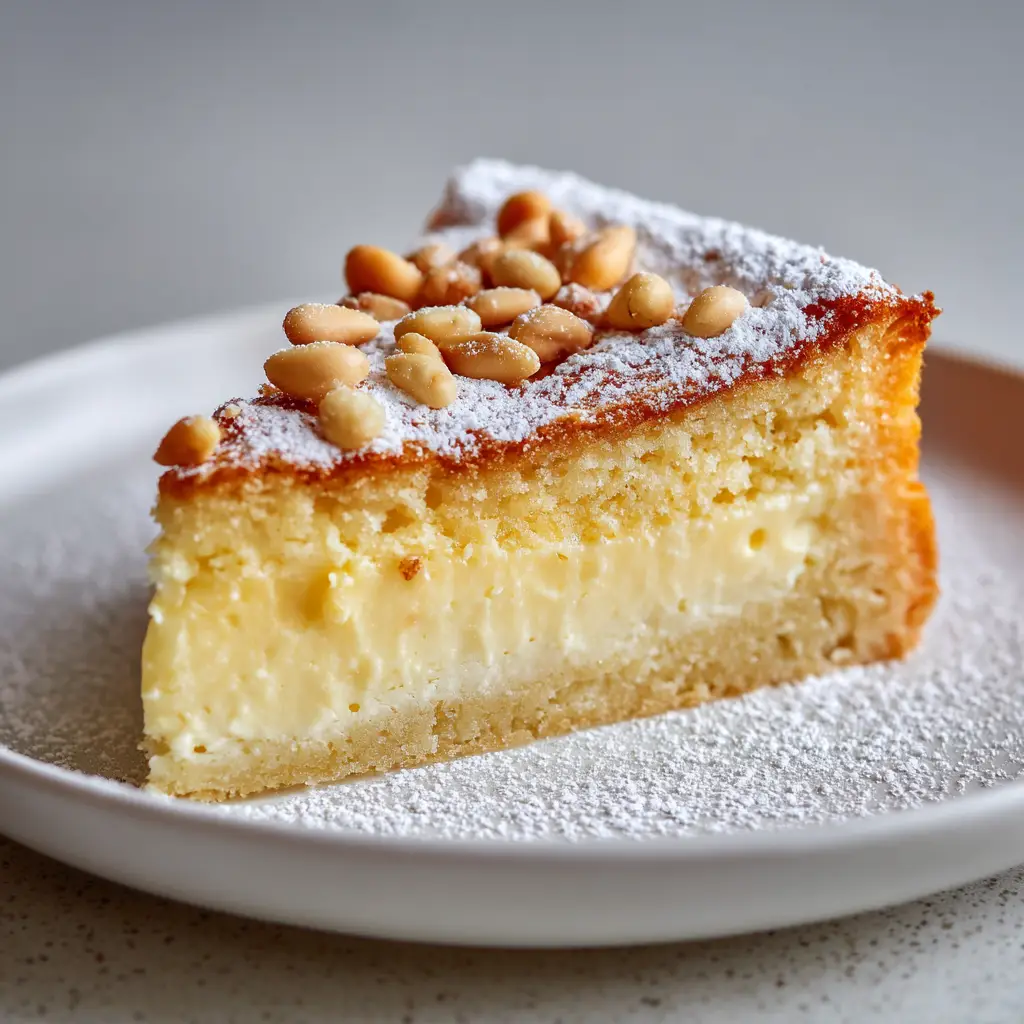
Topped with a matching golden-brown shortcrust pastry top crust, generously dusted with fine white powdered sugar, and scattered lightly with toasted golden pine nuts, it looks like it belongs in a minimalist food photography shoot. Let’s dive into the sensory cues and scientific techniques needed to build this incredible masterpiece.
Why This Sensational Italian Lemon Custard Cake Will Steal the Show
- Structural Integrity: The robust shortcrust pastry base (Pasta Frolla) is expertly formulated to support the heavy, dense custard filling without becoming soggy.
- Sensory Citrus Experience: Freshly grated zest and juice create a pale yellow glossy lemon custard that dances on the palate.
- Visual Perfection: The contrast of the golden-brown crust, bright white powdered sugar, and toasted pine nuts delivers bakery-level aesthetics.
- Textural Harmony: Every bite yields a satisfying crunch from the pastry crust, instantly followed by the incredibly smooth, thick custard center.
Essential Components for the Ultimate Lemon Pastry Cream and Buttery Crust
Creating an impeccable Italian Lemon Custard Cake requires highly specific ingredients that serve crucial architectural and flavor roles. Accurate measurements ensure your dough achieves maximum flakiness while your custard sets into a perfect, sliceable density.
Cold Unsalted Butter: You will need 3/4 cup (170g) of chilled, cubed butter for the pastry dough. Cold fat is the secret to creating those beautiful, flaky layers in the golden-brown shortcrust base.
All-Purpose Flour: Use exactly 2 1/2 cups (300g) of flour for the crust structure. This provides just enough gluten development to hold the heavy custard without turning tough.
Granulated Sugar: You will need 1/2 cup (100g) for the pastry dough and 3/4 cup (150g) for the filling. The sugar not only sweetens the cake but also acts as a vital tenderizer and helps achieve that baked golden-brown finish.
Baking Powder: A mere 1 tsp (5g) added to the flour mixture provides the foundational invisible lift. This prevents the top and bottom crusts from becoming overly dense during baking.
Whole Milk: Heat 2 cups (480ml) of whole milk as the base for your rich pastry cream. The fat content in whole milk ensures the custard remains glossy and luxurious.
Egg Yolks and Whole Eggs: You need 2 whole eggs for binding the pastry dough, and 4 large egg yolks to thicken and enrich the filling. The yolks are exactly what give the custard its signature smooth, pale yellow hue.
Cornstarch: Utilize 1/3 cup (40g) of cornstarch to thicken the lemon filling. This culinary workhorse ensures the thick and dense middle layer sets beautifully upon cooling.
Fresh Lemons: You will extract 1/2 cup (120ml) of fresh lemon juice and 1 tbsp (6g) of zest. Natural citrus oils are scientifically required to cut through the richness of the egg yolks and butter.
Pine Nuts (Pignoli): Prepare 1/4 cup (35g) of pine nuts to scatter across the top. Toasting these releases essential oils, offering a subtle, earthy crunch against the soft filling.
Powdered Sugar: A generous 2 tbsp (15g) dusting over the cooled pastry provides a fine white finish. It creates a stunning visual contrast against the baked golden-brown shortcrust pastry top crust.
Baking Tools for a Structurally Perfect Cake
To execute the flawless visual anatomy of this Italian Lemon Custard Cake, you need the right tools. A 9-inch (23cm) springform pan or tart pan with a removable bottom is non-negotiable for easy release.
You will also need a heavy-bottomed saucepan to prevent the custard from scorching. A sturdy balloon whisk is required to vigorously agitate the cornstarch and egg yolks, ensuring a completely lump-free, pale yellow glossy lemon custard.
Crafting Your Masterpiece: From Dough to Dense Pale Yellow Custard
Mixing and Chilling the Pasta Frolla Dough
In a large mixing bowl, whisk together 2 1/2 cups (300g) of all-purpose flour, 1/2 cup (100g) granulated sugar, and 1 tsp (5g) baking powder. Cut in 3/4 cup (170g) of cold, cubed butter using a pastry blender until the mixture resembles coarse sand.
Add 2 whole eggs and gently knead until the dough just comes together into a cohesive ball. Do not overwork it. Divide the dough into two discs, wrap tightly in plastic wrap, and chill in the refrigerator for at least 1 hour to relax the gluten.
Whisking the Glossy Lemon Custard Filling
While the dough chills, pour 2 cups (480ml) of whole milk into your heavy-bottomed saucepan. Bring it to a gentle simmer over medium heat, watching for tiny bubbles around the edges.
In a separate heat-proof bowl, vigorously whisk 4 egg yolks, 3/4 cup (150g) sugar, and 1/3 cup (40g) cornstarch until pale and smooth. Slowly temper the eggs by streaming the hot milk into the yolk mixture while whisking constantly.
Return the entire mixture to the saucepan over medium-low heat. Whisk continuously until the custard thickens into a dense, smooth pale yellow consistency. Remove from heat, stir in 1/2 cup (120ml) lemon juice and 1 tbsp (6g) zest, then cover with plastic wrap touching the surface to prevent a skin from forming. Let it cool completely.
Assembling and Baking to Golden-Brown Perfection
Preheat your oven to 350°F (175°C). Roll out one of the chilled dough discs on a floured surface to about 1/8-inch (3mm) thickness. Carefully transfer it into your 9-inch (23cm) springform pan, pressing it firmly up the sides to form a sturdy base.
Pour the cooled, thick lemon custard directly into the unbaked crust, smoothing the top with a spatula. Roll out the second dough disc and gently lay it over the filling, pinching the edges together with the bottom crust to seal the Italian Lemon Custard Cake completely.
Scatter 1/4 cup (35g) of pine nuts lightly across the top crust, pressing them in slightly so they adhere. Bake for 40-45 minutes until you see the visual cue of a baked, buttery golden-brown shortcrust pastry top.
Pro-Level Troubleshooting for a Flawless Slice
- Preventing a Soggy Bottom: Ensure your custard filling is completely cooled before pouring it into the raw dough base. A warm filling will melt the butter in the crust, ruining the baked golden-brown shortcrust pastry base.
- Lump-Free Custard: If your pale yellow glossy lemon custard develops lumps during cooking, vigorously whisk it off the heat or press it through a fine-mesh sieve before cooling.
- Slicing Aesthetics: To achieve that distinct visual anatomy shown in minimalist food photography, the cake must be completely chilled (at least 4 hours) before slicing. Attempting to slice it warm will cause the thick and dense middle layer to collapse.
- Toasted Pine Nut Perfection: If your pine nuts are browning too quickly in the oven, tent the top of the cake loosely with aluminum foil for the final 15 minutes of baking.
Preserving the Freshness of Your Lemon Pastry Creation
Because of the dairy-rich filling, this Italian Lemon Custard Cake must be stored in the refrigerator. Wrap the cake tightly in plastic wrap or store it in an airtight cake dome to prevent the delicate pastry from absorbing other fridge odors.
It will keep perfectly for up to 4 days. Before serving, apply a fresh dusting of fine white powdered sugar to revive its visual appeal. Freezing is not recommended, as the cornstarch-thickened custard may separate and lose its smooth, glossy texture upon thawing.
Perfect Pairings for an Italian Dessert Spread
Serving this dessert at a dinner party provides a fantastic opportunity to elevate the entire meal. It acts as an incredibly refreshing palate cleanser following heavy, savory dishes.
If you’re exploring the mechanics of brilliant pastry crusts, you might also enjoy studying the techniques in our savory and sweet tart crust recipes. For those who simply adore luxurious textures, this cake pairs wonderfully with other luxurious layered cake textures.
Want to lean entirely into the fruit-infused sweet space? Serve a slice alongside a strong espresso and check out our vibrant fruit-infused custard desserts for your next baking adventure.
Frequently Asked Questions About Custard Baking
While traditional to Italian tortas and highly recommended for their buttery crunch, you can omit them or substitute them with thinly sliced toasted almonds if preferred.
Yes! In fact, it is highly recommended. The cake requires at least 4 hours of chilling time to allow the thick and dense middle layer of lemon custard to set properly before slicing.
For the best flavor and acidity balance to cut through the egg yolks and whole milk, fresh lemon juice and zest are strongly required. Bottled juice lacks the vibrant, glossy flavor profile needed.
The most crucial step is allowing the pale yellow lemon custard to cool completely before pouring it into the unbaked dough. If poured in hot, the butter in the crust will melt prematurely.
A runny filling usually means the cornstarch wasn’t activated properly. You must whisk the custard continuously over medium-low heat until it heavily thickens and you see gentle bubbling before removing it from the stove.
The Complete Italian Lemon Custard Cake Recipe
The Ultimate Italian Lemon Custard Cake: A Masterclass in Texture
Ingredients
Equipment
Instructions
- In a large mixing bowl, whisk together 2 1/2 cups (300g) of all-purpose flour, 1/2 cup (100g) granulated sugar, and 1 tsp (5g) baking powder.
- Cut in 3/4 cup (170g) of cold, cubed butter using a pastry blender until the mixture resembles coarse sand. Add 2 whole eggs and gently knead until the dough just comes together into a cohesive ball.
- Divide the dough into two discs, wrap tightly in plastic wrap, and chill in the refrigerator for at least 1 hour.
- Pour 2 cups (480ml) of whole milk into your heavy-bottomed saucepan. Bring it to a gentle simmer over medium heat.
- In a separate heat-proof bowl, vigorously whisk 4 egg yolks, 3/4 cup (150g) sugar, and 1/3 cup (40g) cornstarch until pale and smooth. Slowly stream the hot milk into the yolk mixture while whisking constantly.
- Return the mixture to the saucepan over medium-low heat. Whisk continuously until the custard thickens into a dense, smooth pale yellow consistency. Remove from heat, stir in lemon juice and zest, cover with plastic wrap touching the surface, and cool completely.
- Preheat your oven to 350°F (175°C). Roll out one chilled dough disc to 1/8-inch (3mm) thickness. Transfer it into your 9-inch (23cm) springform pan, pressing it firmly up the sides.
- Pour the cooled lemon custard into the unbaked crust. Roll out the second dough disc, lay it over the filling, and pinch the edges together with the bottom crust to seal.
- Scatter 1/4 cup (35g) of pine nuts across the top crust. Bake for 40-45 minutes until the pastry is a buttery golden-brown. Cool completely, chill for 4 hours, and dust with powdered sugar before serving.
Notes
The cake must be completely chilled (at least 4 hours) before slicing to maintain structural integrity.
Share Your Baking Success and Connect
Crafting the perfect Italian Lemon Custard Cake is an incredibly rewarding culinary accomplishment. When you successfully slice into that beautiful, thick pale yellow filling, you’ll know the precise science and foundational techniques paid off.
We’d love to see your stunning, realistic food photography of this dessert! Please leave a comment and a 5-star rating below to let us know how your pastry turned out. Don’t forget to join our newsletter for more elite recipes and follow us over on Pinterest to share your masterpieces!